Why Montenegro · Tax
Low headline rates, and extra relief for four- and five-star hotels
Montenegro taxes company profit at no more than 15% and charges a reduced VAT rate on accommodation and food service. On top of the general regime sit reliefs aimed squarely at high-category hotels. This page sets out the headline numbers and what they mean for a hotel's returns.
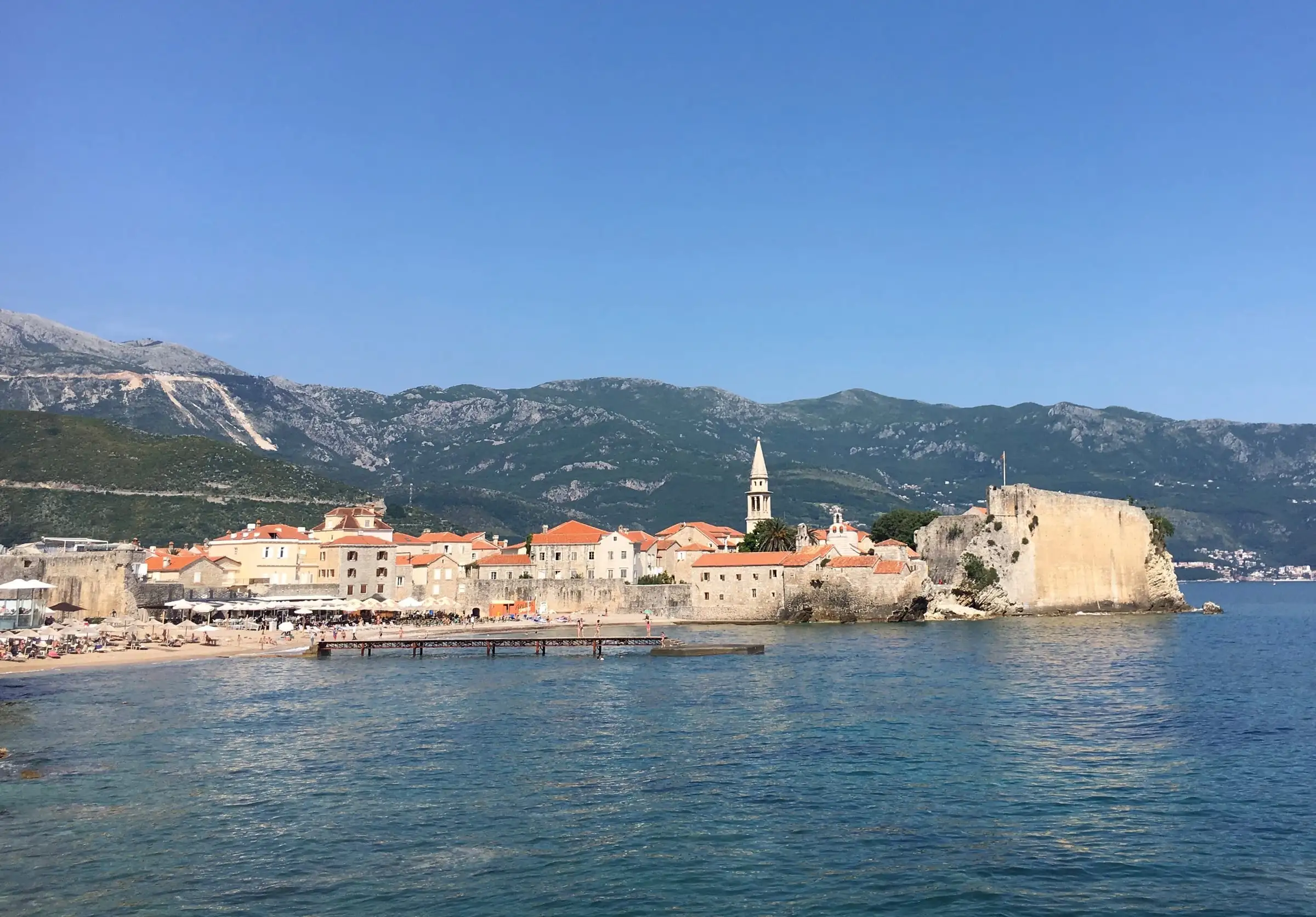
Budva Old Town
15%
Top corporate income tax rate
15%
VAT on accommodation and food service
up to 70%
Property tax reduction, 5-star hotels in priority locations
44
Double taxation agreements in force
Not tax advice
This is a summary of headline rates as the guide reports them for 2026. Rates, scope and eligibility change, and the right structure depends on the project. Take advice from a Montenegrin tax adviser before you rely on any of it.
Profit and income tax
The current system comes from two reform packages: Europe Now, in force from January 2022, and Europe Now 2, from October 2024. Together they made corporate and personal income tax progressive and cut the social security contributions paid by employers and staff.
Corporate income tax has three bands. Profit up to €100,000 is taxed at 9%, profit up to €1.5 million at 12%, and anything above that at 15%. A stabilised resort hotel will pay mostly at the top rate, which the guide counts among the lowest in the region. Personal income tax runs from 9% to 15%.
For a hotel the contribution cuts may matter as much as the profit tax. Payroll is a large share of a hotel's costs, and in a market where wages are rising fast, lower charges on each employee leave more room in the operating budget.
The progressive bands also matter in the early years. A new hotel typically runs at a loss or a thin profit while it ramps up, and the lower bands mean that the first profits are taxed lightly. Check with an adviser how losses carry forward and how group companies are taxed before fixing the structure.
Main tax rates in Montenegro
| Tax | Rate type | Band | Rate (%) | Band from (EUR) | Band to (EUR) |
|---|---|---|---|---|---|
| Corporate Income Tax (CIT) | Progressive rates | On profit up to EUR 100,000 | 9 | 0 | 100,000 |
| Corporate Income Tax (CIT) | Progressive rates | On EUR 100,001–1,500,000 | 12 | 100,001 | 1,500,000 |
| Corporate Income Tax (CIT) | Progressive rates | Above EUR 1,500,000 | 15 | 1,500,000 | — |
| Personal Income Tax (PIT) | Progressive rates | Lowest rate (progressive rates 9% to 15%) | 9 | — | — |
| Personal Income Tax (PIT) | Progressive rates | Highest rate (progressive rates 9% to 15%) | 15 | — | — |
| Value Added Tax (VAT) – standard rate | Standard rate | Standard rate | 21 | — | — |
| VAT – reduced (accommodation & F&B services) | Reduced rate | Excluding alcoholic drinks, sugared and carbonated beverages, and coffee | 15 | — | — |
| Real estate transfer tax | Progressive rates | Up to EUR 150,000 | 3 | 0 | 150,000 |
| Real estate transfer tax | Progressive rates | On EUR 150,001–500,000 | 5 | 150,001 | 500,000 |
| Real estate transfer tax | Progressive rates | Above EUR 500,000 | 6 | 500,000 | — |
Figure 2.1, Main tax rates in Montenegro (UN Tourism, 2026, p. 31). Underlying source: Ministry of Tourism of Montenegro (2026); PwC (2025) Montenegro Tax Summary. Available at: https://taxsummaries.pwc.com/montenegro (Accessed: 17 June 2026).
VAT on rooms and restaurants
The standard VAT rate is 21%. Accommodation and food service carry a reduced rate of 15%. Alcohol, sugared and fizzy drinks, and coffee are excluded and stay at the standard rate, so a hotel's bar and café revenue is taxed differently from its rooms and kitchen.
The guide sets the reduced rate against 20–25% for the equivalent supplies in several competing Mediterranean destinations. On a room rate that includes VAT, every point of tax not paid is either margin for the operator or price headroom against competitors. Check exactly which supplies qualify before building the reduced rate into a revenue model.
Property and transfer taxes
Buying real estate attracts a transfer tax of 3% up to €150,000, 5% up to €500,000 and 6% above that. On a hotel-sized acquisition, most of the value falls in the top band.
Annual property tax is where the hotel-specific reliefs start. Four-star hotels in priority tourist locations can reduce it by up to 30%, and five-star hotels by up to 70%. The tax is progressive by design, so owners have a reason to upgrade tired buildings and to build on land rather than hold it idle.
Five-star projects get two further reliefs at the construction stage. Products and services supplied for the build are exempt from import VAT, and municipal construction contributions for these hotels have been abolished under the Law on Spatial Planning. Both cut the up-front capital bill of a luxury project. The details sit on the high-category hotel incentives page.
New incentives from 2026
The guide reports new tax incentives for digital nomads and strategic investors that can reduce operating costs by up to 30%. It does not set out the conditions, so treat this as a lead to follow up with the Montenegrin Investment Agency and your adviser rather than a number to model. Other instruments, including tourism development zones, business zones, the condo-hotel model and direct investment grants, are covered under instruments.
Treaties
Montenegro had 44 double taxation agreements in force as of November 2025, covering the main European economies and partners in Asia and the Middle East. They deal with dividends, interest, royalties and capital gains, and can lower withholding tax on money paid out to a foreign parent. Whether a treaty applies depends on the investor's eligibility and on domestic anti-abuse rules, so the holding structure needs checking before the first distribution.
Separately, Montenegro has signed around 24 bilateral agreements on the promotion and protection of investments, more than half of them with EU member states. These typically give a foreign investor a treaty-based claim if the state treats the investment unfairly, which matters for long-lived assets such as hotels built on leased state land.