Tourism market · Infrastructure
Getting guests in and keeping the lights on
A hotel is only as good as the routes that reach it. Montenegro's air links have grown fast, a first motorway section has brought the northern mountains within easy reach of the capital, and rail and power are in the middle of large upgrades. Here is where each stands.
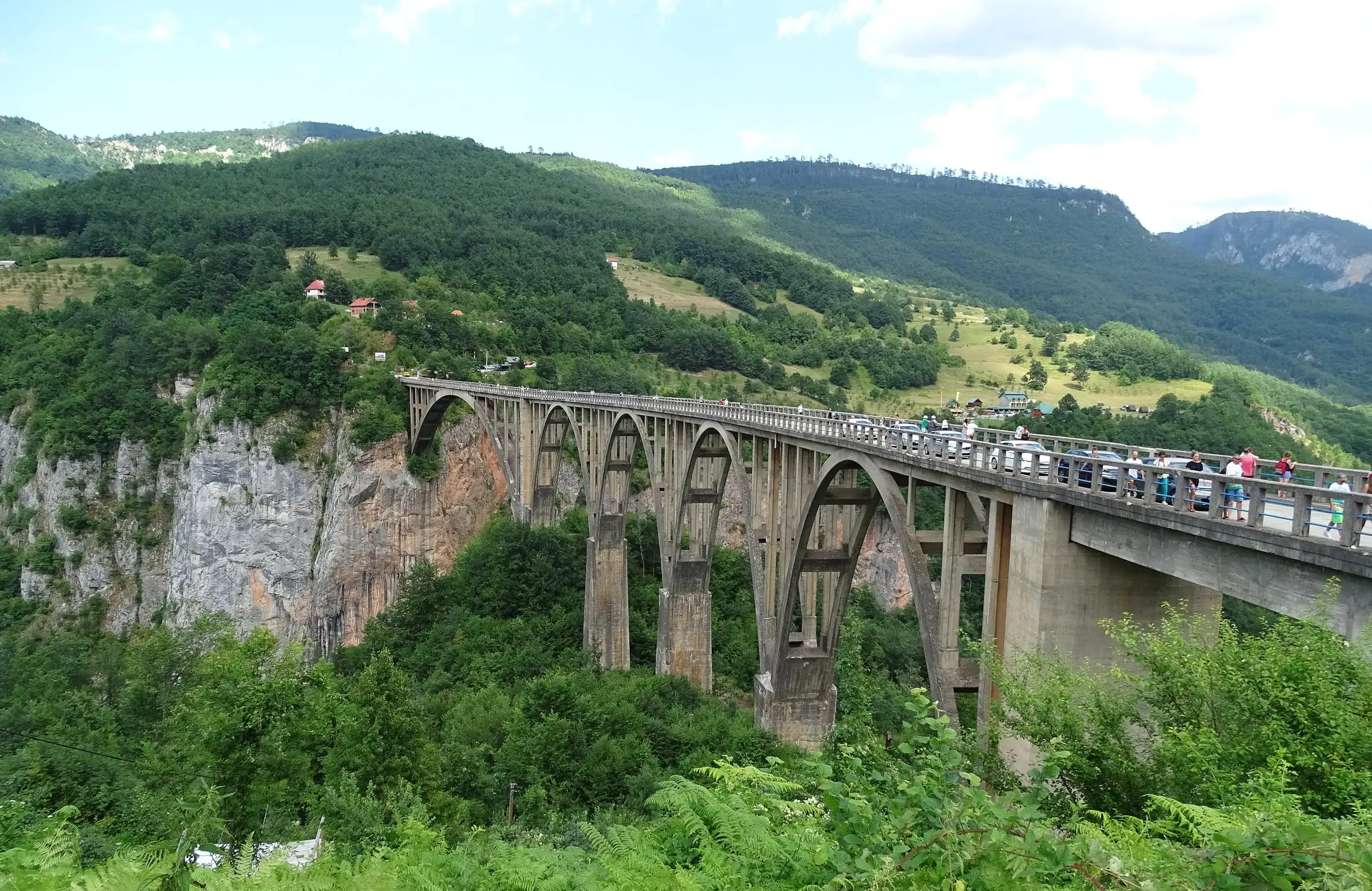
Đurđevića Tara bridge
3.1 million
Passengers through Podgorica and Tivat airports
about 130
Destinations served by air
14
New Wizz Air routes from the Podgorica base
40 km
Motorway in operation (Bar–Boljare, first section)
Air: Podgorica, Tivat and a new low-cost base
Montenegro's international airports are at Podgorica and Tivat. Together they handled a record 3.1 million passengers in 2025 and connect the country with about 130 destinations. Tivat sits inside the Bay of Kotor, minutes from the main resort cluster; Podgorica serves the capital and is the gateway to the north.
The state-owned operator, Airports of Montenegro, reported aviation revenue of €35.9M and EBITDA of €17.7M for 2025. A concession procedure for the airports has been sent to Parliament. If it goes ahead, a private operator would likely take over investment in terminals and capacity. That could ease summer congestion, but it could also change fees and route incentives, so watch the terms.
In 2026 Wizz Air opened its 36th European base in Podgorica, stationing two aircraft there and launching 14 new routes. Summer seasonal flights add direct links from the main Western and Northern European markets. The airports offer discounts on handling and landing fees to airlines that open new routes, and new legislation allows public service obligations so that some routes keep flying in winter.
For investors this is the most important infrastructure story. A based low-cost carrier can fly year-round, which seasonal charter flights usually do not. Whether the new routes hold through the winter will decide much of the north's prospects as a second-season destination.
Road: a first motorway section and a long regional network
The state road network has 40 km of motorway, the first section of the Bar–Boljare corridor, and 1,967 km of main and regional roads. The motorway section links Podgorica with Kolašin in under an hour, through mountain terrain that used to mean a slow canyon drive.
That changes the map for mountain tourism. Kolašin and the ski resorts around it are now a short transfer from Podgorica airport, which makes weekend skiing from the capital and fly-in winter breaks practical. The rest of the corridor, south to Bar and north to the Serbian border, is not yet in operation, so places further north still depend on the older road network.
Rail: an old line under renovation
The railway network covers 250 km, 90% electrified. Its backbone is the Bar–Belgrade line, a scenic route through the mountains with established appeal to tourists. It carried 756,171 passengers in 2025.
A large modernisation programme is under way. The Bar–Golubovci section is being reconstructed at a cost of about €220M, and bridges, tunnels and track on the Lutovo–Bratonožići–Bioče section are being rehabilitated for €80M. EU grants of €152.6M through the Western Balkans Investment Framework support the work, and the EBRD is financing new electric trains worth €30M. Rail will not move many hotel guests, but the line links the coast, the capital and the north, and a reliable service would help car-free visitors reach mountain resorts.
Energy: a transition in progress
The National Energy and Climate Plan sets the course for a faster shift to renewables. The Gvozd wind farm, 54.6 MW, has been commissioned. Auctions are being prepared for 250 MW of solar and 200 MW of wind capacity. The national utility, EPCG, has set up a joint venture with Masdar for renewable projects, and a second undersea power link to Italy is planned for completion by 2031.
For hotel operators, the main interest is green certification, which international brands and tour operators often ask for, and the prospect of on-site solar or supply contracts from new renewable capacity. Large mountain projects should also confirm grid capacity at the site early, since ski lifts and snowmaking draw heavy loads.
Digital and innovation readiness
Montenegro ranked 64th of 139 economies in WIPO's Global Innovation Index 2025, and 14th of 36 among upper-middle-income economies. The ITU's ICT Development Index 2025 gave it a score of 89.7, with 84.2 for universal connectivity and 95.2 for meaningful connectivity. In practice, the scores suggest that online distribution, cashless payment and digital guest services can be relied on in most places a hotel would be built.
The business base around tourism is growing. Micro, small and medium-sized enterprises numbered 51,386 in 2025, up 51% on 2021, and employ over 160,000 people. These are the suppliers, caterers, transport firms and activity operators a hotel depends on. The 2026 Programme for Improving the Competitiveness of the Economy, with a budget of €3.5M, co-finances modernisation and digital transformation for them. The Smart Specialisation Strategy 2026–2031 names sustainable tourism as a priority, and 5 university faculties train people for the sector.
Competitiveness indicators
The guide closes its competitiveness chapter with a handful of indicators. Foreign direct investment came to about €7,800 per resident over 2021–2025, well ahead of the other Western Balkan economies; see foreign direct investment. Branded hotels achieved an average daily rate of $288.51, and $459 in the luxury and upper-upscale tier. And the branded pipeline equals 20.3% of existing branded rooms, a measure of how much developers are committing; see hotel performance.
The guide also cites a European Travel Commission rating of Montenegro as a destination. We have not traced that rating to the Commission itself, so we do not repeat it here.