Tourism market
A tourism economy with a summer problem
Tourism is Montenegro's main export and a large share of its jobs. Visitor numbers are at a record and the top of the hotel market charges premium rates. The weak points are a short season and a stock of beds packed onto the coast.
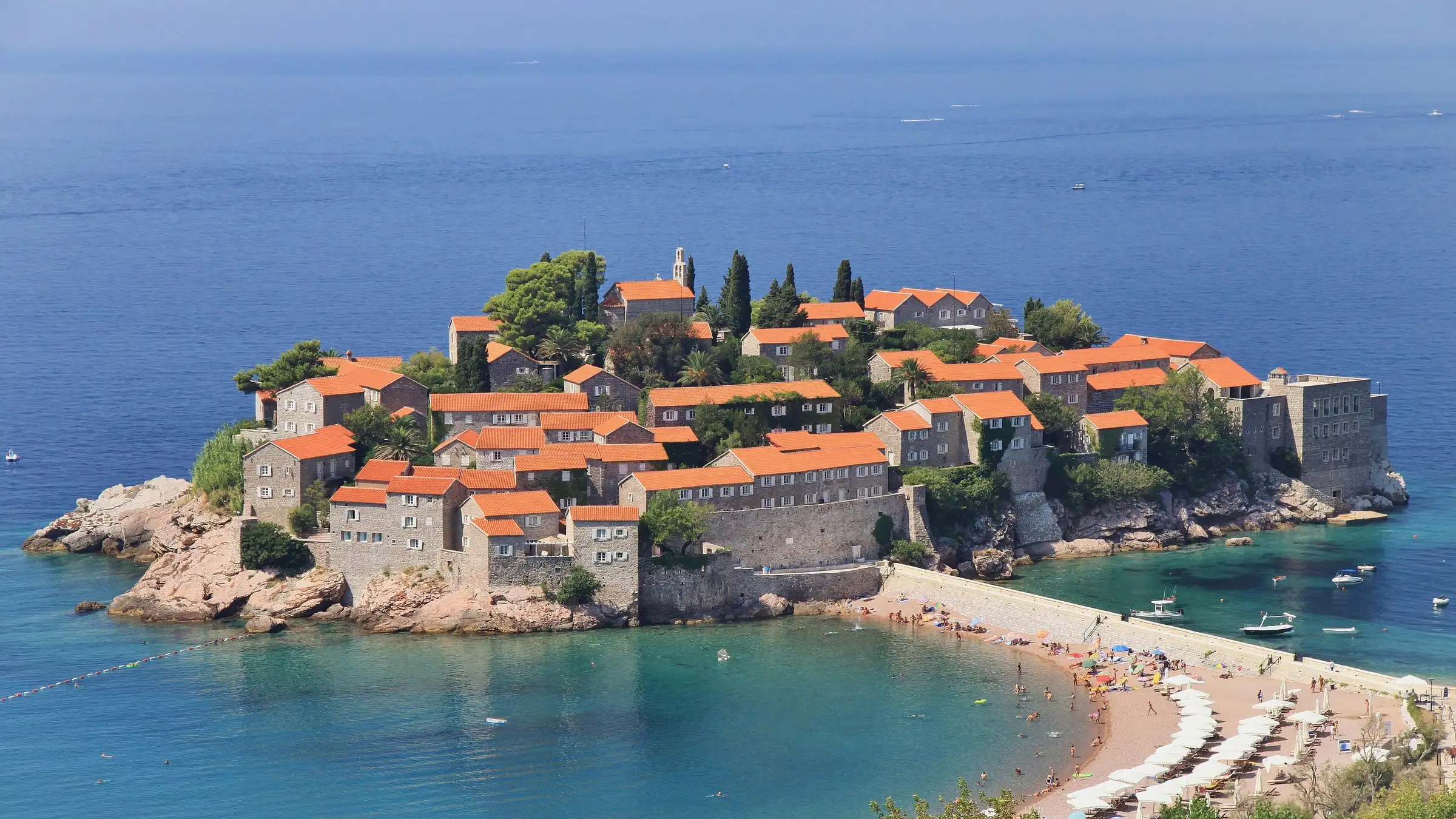
Sveti Stefan
about 45%
Tourism share of total exports
2.73 million
International tourist arrivals
$459
Average daily rate, luxury and upper-upscale
47%
Share of annual overnight stays in July and August
The shape of the market
Tourism weighs more in Montenegro's economy than in any of its Western Balkan neighbours. It brought in about 45% of all export revenue and 56% of commercial services exports in 2024. The IMF's 2025 review found that accommodation and food services make up a larger share of jobs here than in any of the Central European and Western Balkan economies it compared. When tourism does well, the whole economy does. The reverse is also true, which is why the Government treats the sector as a priority in its spending on roads, airports and mountain resorts.
Demand is at a record. International arrivals reached 2.73 million in 2025, and almost all visitors come from abroad. Receipts, though, have slipped since 2023, so more visitors have not meant more spending. The visitors themselves split into a regional base from Serbia, Bosnia and Herzegovina and other neighbours, and a growing Western European and long-haul layer that arrives mostly by air.
The top of the market is strong. Branded luxury hotels averaged $459 a night in the year to July 2026, and four- and five-star properties hold most of the country's categorised beds. Developers are building more: the branded pipeline equals 20.3% of existing branded rooms.
Two weaknesses run through every page in this section. The first is seasonality: July and August bring 47% of overnight stays, and luxury hotels were less than half full over the year. The second is geography: the coast has 86.49% of categorised beds, the north under 6%. Government strategy, the ski resort programme and most of the opportunities on this site aim at both at once, by building a winter season in the mountains. For an investor, that sets the question for any project: not whether people come to Montenegro, but whether a given site can earn outside July and August.
In this section
- Arrivals and receipts Record visitor numbers since 2020, why spending has lagged, and the European backdrop.
- Source markets and seasonality Who visits, when they come, and the products meant to stretch the season.
- Accommodation supply The categorised hotel stock by star rating and region, and the gap in the north.
- Hotel performance Branded stock and pipeline, daily rates, occupancy and the limits of the data.
- Nautical and cruise The marinas and their berths, superyacht capacity, cruise ports and ferries.
- Tourism strategy Government priorities old and new, and the protected areas that underpin them.
- Infrastructure Airports, roads, rail, energy and digital readiness, with the projects under way.