Tourism market · Hotel performance
High rates, a deep off-season, and a busy pipeline
Branded hotels in Montenegro charge Mediterranean resort prices, and the luxury end charges a good deal more. Occupancy tells the other half of the story: strong in summer, weak across the year. A construction pipeline equal to 20.3% of existing branded rooms shows developers are betting the rates will hold.
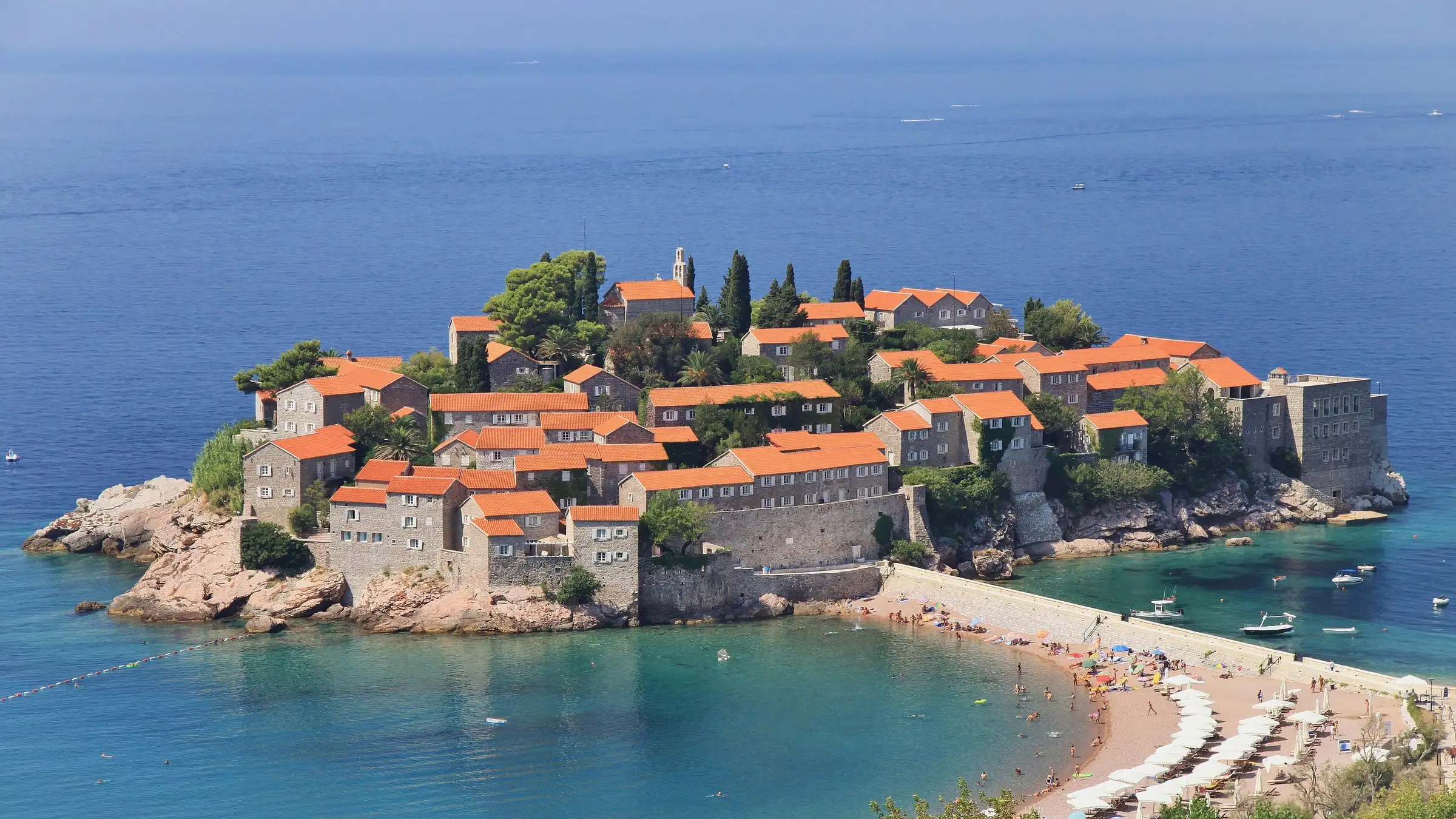
Sveti Stefan
$288.51
Average daily rate, branded hotels
52.9%
Occupancy, branded hotels
$459
Average daily rate, luxury and upper-upscale
20.3%
Pipeline as a share of existing branded rooms
The branded stock and what is being built
The guide counts 89 branded hotels with 9,880 rooms as of July 2026. "Branded" is defined broadly: international chains, domestic chains, franchises, management contracts and soft-brand collections all count, while independent hotels do not. Branded residences count only where the same brand also runs hotel rooms on site. The count matches the market-data sample behind the performance figures below, so it reflects one data provider's coverage rather than an official register.
A further 13 branded properties with 2,007 rooms are under construction. That pipeline equals 20.3% of the existing branded room count, a large addition for a small market to absorb. When it opens, competition for staff and for shoulder-season guests will rise along with the room count. A new entrant should test its forecast against the larger market of a few years from now, not against today's.
Do not set the branded count against the categorised register and read off a share. The two come from different sources with different definitions: the branded count is a market-data sample, the register is the Ministry's list of categorised establishments.
Rates, RevPAR and occupancy
Over the twelve months to July 2026, the reporting sample achieved an average daily rate of $288.51, revenue per available room of $152.51 and occupancy of 52.9%. Occupancy reached 81.1% in July 2026, the peak month.
The sample splits into two reported tiers. Luxury and upper-upscale hotels, with 3,754 rooms, averaged $459 a night at 44.5% occupancy, for RevPAR of $205. Upscale and upper-midscale hotels, with 4,418 rooms, averaged $172 at 58.9%, for RevPAR of $101.
The luxury rate is the headline the guide leans on, and it is a strong number for a country this size. It supports the case that guests will pay international resort prices on the Montenegrin coast, and it is consistent with incentives that favour five-star product.
What luxury occupancy says about the season
The more telling figure is that luxury hotels were less full than the tier below them. Over a year, a luxury room sat empty more often than it was sold. The likeliest explanation is seasonality. Luxury product here is mostly coastal resort product, built around the beach and the marina, and it tends to run close to full for a few months and then go quiet once the season ends. The tier below probably holds a larger share of city hotels that sell to business travellers all year, which smooths their curve. The sample does not let us check that directly.
The gap between peak-month and annual occupancy across the sample makes the same point. For an investor, it changes the model. A luxury resort here earns much of its year in a short summer window, so labour, maintenance and debt service have to be covered from a compressed revenue base. Projects that add year-round revenue, such as branded residences under a rental programme, a spa, meeting space or a marina, are easier to finance than a pure summer hotel. The condo-hotel model lets a high-category hotel sell individual units to private buyers while keeping one operator, which can repay part of the capital before the hotel stabilises.
The brands already here
International operators span the range from ultra-luxury to upscale. Most sit in the Bay of Kotor and around Budva, with Hilton and Crowne Plaza in Podgorica and Swissôtel in the mountain town of Kolašin. Names below are printed as they appear in the guide's table.
International Hospitality Brands Present in Montenegro (2026)
| Brand/operator | Property | Location |
|---|---|---|
| Aman | Aman Sveti Stefan | Budva |
| One&Only | One & Only Portonovi | Herceg Novi |
| SIRO | SIRO Boka Place | Tivat |
| Banyan Tree | Mamula Island by Banyan Tree | Herceg Novi |
| Angsana | Centrale LusticaBay by Angsana | Tivat |
| The Chedi | The Chedi LušticaBay | Tivat |
| Regent Hotels & Resorts | Regent Porto Montenegro | Tivat |
| Mövenpick | Movenpick Hotel & Residences Teuta Kotor Bay | Kotor |
| Swissôtel | Swissotel Resort Kolašin | Kolašin |
| Hyatt | Hyatt Regency Kotor Bay Resort | Kotor |
| Crowne Plaza | Crowne Plaza Podgorica | Podgorica |
| Hilton | Hilton Podgorica | Podgorica |
| Iberostar | Iberostar Waves Slavija; Iberostar Waves Bellevue; Ibersotar Waves Herceg Novi | Budva; Herceg Novi |
Table 4.2, International Hospitality Brands Present in Montenegro (2026) (UN Tourism, 2026, p. 57). Underlying source: Ministry of Tourism of Montenegro (2026).
The pipeline adds more names. Properties under construction include hotels under the Meliá, InterContinental, Radisson Blu, Pullman, Swissôtel, Crowne Plaza, Hyatt Centric, JANU and Mövenpick brands, concentrated along the Budva–Tivat coast and in the Kolašin mountain cluster. Several of those brands are already present, which shows operators adding properties rather than testing the market once. The fact that part of this pipeline is in Kolašin is a clear private-sector sign that the northern ski strategy is being taken seriously.
The limits of the data
All of the performance figures come from a single licensed market report, and its coverage is narrower than the headlines suggest.
How to read the hotel performance sample
- It is a sample of 89 chain-scaled hotels, not a census of the country's accommodation. Private rooms, apartments and other non-hotel capacity are excluded.
- It treats Montenegro as one market, mixing coastal resorts with inland and city hotels. There is no split by region or town.
- The midscale and economy tier (1,708 rooms) reports no occupancy, rate or RevPAR, so the averages reflect only the two upper tiers.
- Rates are in US dollars over the twelve months to July 2026. The report does not say whether they include VAT and the local tourist tax.
Use these numbers as a ceiling for well-located branded hotels, not as a benchmark for any hotel in Montenegro. For a specific site, commission a local feasibility study with comparable properties, monthly data and net-of-tax rates. Our due diligence page lists what to ask for.