Tourism market · Arrivals
Record arrivals, softer receipts
Visitor numbers have more than recovered from the pandemic and set a new high in 2025. Spending has not followed: receipts peaked in 2023 and have eased since. For anyone underwriting a hotel, the second line matters more than the first.
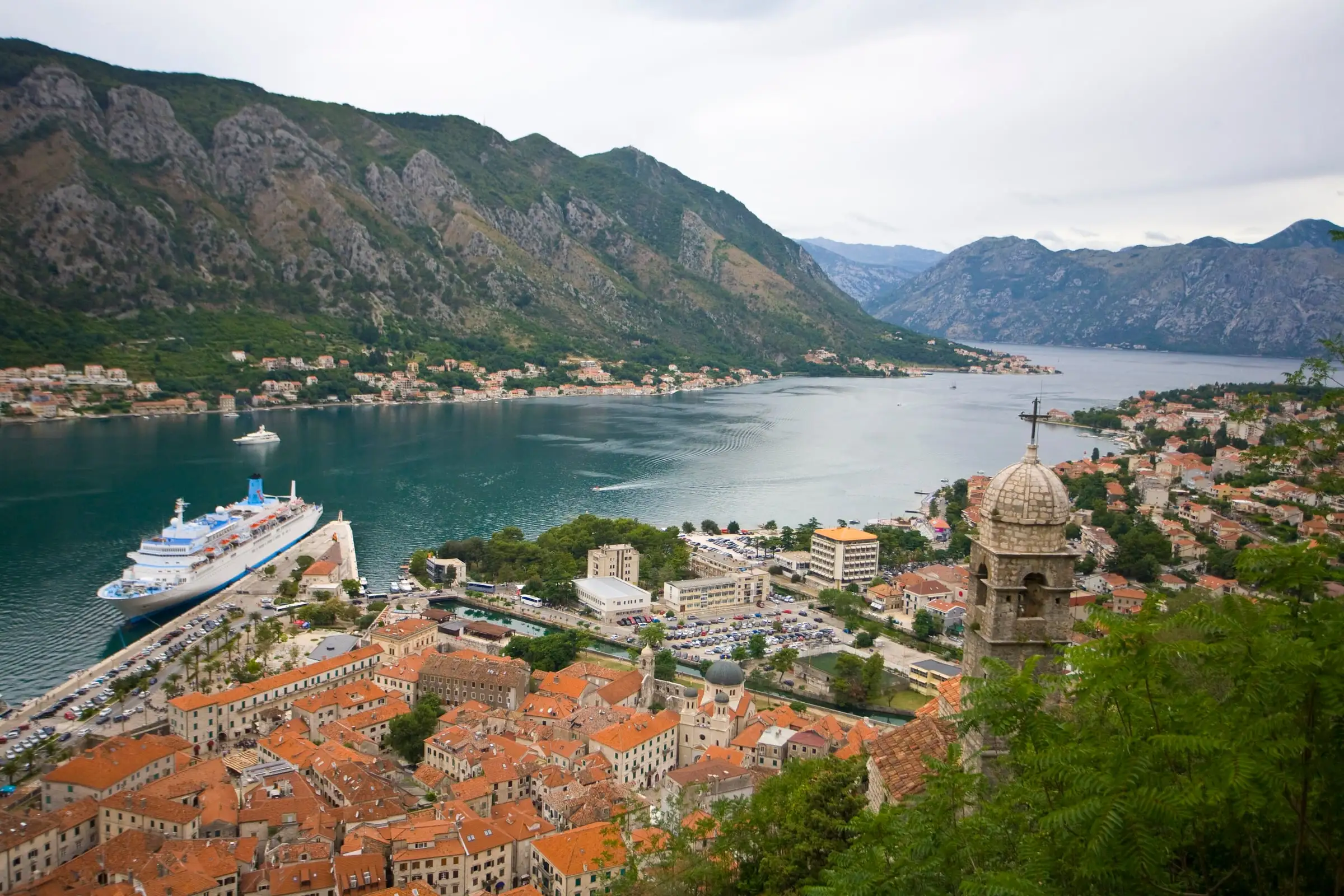
Kotor Old Town
2.73 million
International tourist arrivals
$1.48bn
International tourism receipts
over 90%
International share of all arrivals
176,063
Domestic tourists
From a standstill to a record in five years
In 2020 the border closures cut international arrivals to 351,000, a fraction of a normal season. The rebound was fast. Arrivals reached 1.55 million in 2021, climbed through 2022 and levelled off at 2.45 million in 2023 and 2.44 million in 2024. In 2025 they broke out of that plateau to 2.73 million, the highest figure on record.
Arrivals here are overnight visitors registered in accommodation, so they leave out cruise passengers and same-day visitors. That makes them a fair proxy for demand that actually fills beds. The pause between 2023 and 2024 is worth noting: it suggests the post-pandemic catch-up had run its course, and that the 2025 jump came from new demand rather than pent-up travel. New air routes are the likeliest candidate, though the guide does not attribute it.
International Tourism Statistics, Montenegro, 2020–2025
Show the data
| Year | International tourist arrivals (million) | International tourism revenue (USD billion) |
|---|---|---|
| 2020 | 0.35 | 0.17 |
| 2021 | 1.55 | 0.9 |
| 2022 | 2.04 | 1.08 |
| 2023 | 2.45 | 1.63 |
| 2024 | 2.44 | 1.58 |
| 2025 | 2.73 | 1.48 |
Figure 4.1, International Tourism Statistics, Montenegro, 2020–2025 (UN Tourism, 2026, p. 50). Underlying source: UN Tourism (2026). World Tourism Barometer, Vol. 24, No. 2, May 2026. Madrid: UN Tourism. https://doi.org/10.18111/wtobarometereng (Accessed: 20 July 2026). MONSTAT (2026). Arrivals and Overnights of Tourists, Total 2025. Podgorica: MONSTAT. https://www.monstat.org/uploads/files/TURIZAM/ukupno/2025k/Arrivals%20and%20overnights%20of%20tourists%20total%202025.pdf (Accessed: 19 August 2026)
Receipts have not kept pace
Put the two charts side by side and they part ways after 2023. International tourism receipts peaked at $1.63bn that year, slipped to $1.58bn in 2024 and fell again to $1.48bn in 2025, the year arrivals hit their record. More visitors brought in fewer dollars, so spending per arrival dropped for two years running.
The guide does not explain the gap, and we should not pretend to. Plausible causes include shorter stays, a shift in the visitor mix toward lower-spending markets, more visitors in private rentals that capture less of their spend, and the fact that receipts are reported in US dollars. The two series also come from different sources: arrivals from the national statistics office, receipts from UN Tourism's World Tourism Barometer. Small differences in method can move a ratio like this.
What an investor can take from it is narrower but useful. Headline arrival growth is not evidence of rising yields. If spend per visitor keeps falling while arrivals rise, roads, water and staff come under more pressure without a matching rise in revenue. Build the case on overnight stays, average length of stay and rate data, not on visitor counts. The hotel performance figures, which do show strong rates at the top of the market, are a better guide to what a well-run property can earn.
Almost entirely an export business
International tourists made up over 90% of all arrivals in 2025, up from about 79% in 2020, when international travel was restricted and residents holidayed at home. Domestic tourism is small but growing: 176,063 domestic tourists in 2025 was the highest number on record. Domestic guests still matter at the margin: they fill weekends and shoulder-season dates, especially for northern and inland hotels within driving distance of Podgorica.
With a resident population of 623,600, the home market cannot carry a hotel on its own. Demand depends on foreign visitors, which in turn depends on flights, visa rules and the health of a handful of source economies. The upside is that tourism earns hard currency: it brought in about 45% of all export revenue in 2024. A sector that important to the balance of payments tends to get priority from government, from airport slots to road budgets.
The European backdrop
Montenegro grew in a market that was also growing. Europe received about 810 million international arrivals in 2025, up 5% on the year and 9% above 2019 levels. Southern and Mediterranean Europe, Montenegro's direct competitive set, took 344 million, up 4%.
Against that, Montenegro's 2025 arrivals rose much faster than either regional average, from a very small base. Montenegro remains a rounding error in Mediterranean volumes, which is both the risk and the opportunity. A few new routes or one large resort can move national numbers, but so can a single bad season in a key source market. Larger Mediterranean destinations compete hard for mass coastal demand on price, which is one reason the state is pushing upmarket and inland rather than chasing volume.
What to watch
Three things will tell you whether the 2025 record is a new floor. First, whether receipts turn back up in 2026; a third year of falling spend per visitor would point to a structural mix problem. Second, whether the extra arrivals spread into the shoulder months, which the seasonality data suggests is starting to happen. Third, whether new air capacity holds through the winter rather than flying only in summer. Each of these is covered elsewhere in this section, and the national statistics office publishes the monthly series that underpins them.