Tourism market · Source markets and seasonality
Regional volume, Western European upside, and a two-month summer
Montenegro's visitors come mostly from its neighbours, with Western European and long-haul markets adding a second, more distant layer. Almost half of all overnight stays fall in two summer months. That concentration, more than any other single factor, decides what a hotel here can earn over a year.
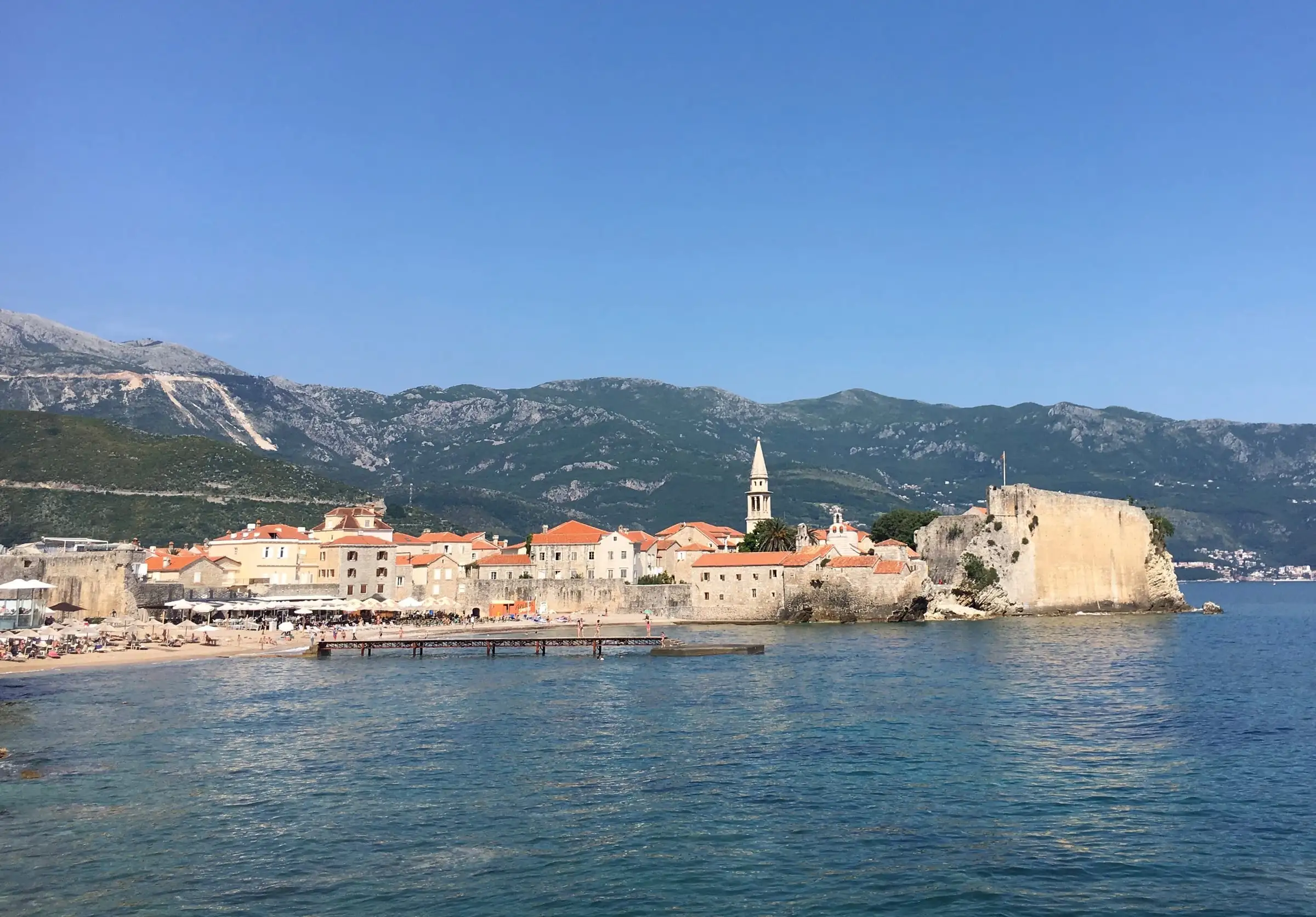
Budva Old Town
about 41%
Share of annual arrivals in July and August
47%
Share of annual overnight stays in July and August
+13.3%
Growth in September arrivals
+10.5%
Growth in October arrivals
Two kinds of source market
Serbia is the largest source of international arrivals by a wide margin, followed by Russia and Bosnia and Herzegovina. Kosovo also sits in the top ten. These regional markets share a language or a border with Montenegro, often travel by car or on short flights, and know the coast well. They supply the volume that keeps beds filled in July and August.
The second group is further away. Germany, the United Kingdom and France form a Western European block in the top ten, alongside Türkiye, Israel and Poland. The guide presents these markets as the source of the destination's growth and as a rising share of arrivals. They arrive mostly by air, so their numbers follow the airline schedule closely, and they are the markets that the new Wizz Air base and the summer routes from Western and Northern Europe are aimed at.
For a hotel investor, the two groups imply different products. Regional guests tend to be loyal, price-aware and concentrated in high summer. In most Mediterranean markets, Western European and long-haul guests are more likely to book international brands, travel in the shoulder months and pay for wellness, golf or marina access, though the guide offers no spend data to prove that for Montenegro specifically.
Top ten source markets by arrivals, 2024 and 2025
Show the data
| Rank | Country | 2025 (arrivals) | 2024 (arrivals) |
|---|---|---|---|
| 1 | Serbia | 461,262 | 449,164 |
| 2 | Russia | 203,945 | 198,025 |
| 3 | Bosnia and Herzegovina | 200,788 | 207,392 |
| 4 | Germany | 147,734 | 144,172 |
| 5 | Türkiye | 134,266 | 164,902 |
| 6 | United Kingdom | 118,746 | 111,844 |
| 7 | Israel | 110,249 | 73,513 |
| 8 | France | 98,517 | 93,778 |
| 9 | Kosovo | 86,956 | 98,865 |
| 10 | Poland | 86,609 | 82,524 |
Figure 4.2, Top 10 Source Markets by International Arrivals, 2024–2025 (UN Tourism, 2026, p. 52). Underlying source: MONSTAT, Arrivals and overnights of tourists, total 2025 and total 2024 (Release 23-2/2025), Table 3: foreign tourist arrivals by country of residence
We corrected the guide's chart
The guide's version of this chart pairs most of the 2024 figures with the wrong countries. The figures above come from the national statistics office's own 2024 and 2025 releases. They confirm the guide's text: Germany, the United Kingdom, France, Israel and Poland all grew between the two years, while Türkiye and Kosovo fell.
Arrivals are not revenue
The guide makes a point worth repeating: arrival counts say nothing about how long a visitor stays or how much they spend. A family from a neighbouring country that drives in for two nights in a private apartment and a couple that flies in for a week at a five-star resort count the same. The weak relationship between arrivals and receipts in recent years shows why this matters. When you size demand for a project, ask for overnight stays and average length of stay by market, and look for spend surveys, before you lean on arrival rankings.
A season compressed into July and August
Seasonality is the defining weakness of the market. July and August together account for about 41% of annual arrivals and 47% of overnight stays. The overnight share is higher than the arrivals share, which means peak-season visitors stay longer than the average guest. Outside those weeks the coast thins out quickly.
The effect shows clearly in hotel results. Branded hotels ran at 81.1% occupancy in July 2026 but averaged 52.9% over the year to July. In the luxury and upper-upscale tier the annual average was lower still, at 44.5%. A resort that is full at the summer peak and half-empty or closed for much of the rest has to earn its fixed costs, staff housing and debt service from a short window, which raises risk and narrows the investor pool.
The shoulder months are growing
There is movement at the edges. In 2025, September arrivals were up on the year (+13.3%), and so were October arrivals (+10.5%). That is consistent with the Government's season-extension policy. Two good months do not make a trend, and the figures are growth rates rather than levels, so they say nothing on their own about how full hotels were in October. But the direction is right, and it is the variable most worth tracking in the monthly statistics.
Products that flatten the year
Policy aims to fill the gaps with products that peak at different times. The tourism strategy now in preparation names season extension beyond the June–September coastal peak as its first priority.
- Mountain resorts in the north create a second, winter peak and allow four-season operation where summer hiking and biking follow ski season. The state is building the ski infrastructure itself; see the opportunities for the resorts and the land around them.
- MICE, meetings and conferences, books mostly in spring and autumn, the very months the coast struggles to fill. That favours hotels with proper meeting space and good airport access.
- Wellness and health tourism is less weather-dependent and has an established base at Igalo, near Herceg Novi.
- Nautical tourism keeps marina towns busy well beyond the bathing season, with yacht owners and crews spending through spring and autumn. See nautical and cruise.
For an investor, the lesson is to underwrite a coastal hotel on its weakest months, not its best, and to give real weight to the features that earn off-season revenue: meeting rooms, spa, year-round restaurants and partnerships with marinas or ski operators. In the north the calculation is reversed. Mountain hotels can work two seasons, but only once the lifts, roads and flights that bring winter guests are in place.